



2026 Honda Civic Hatchback vs. 2026 Mazda 3
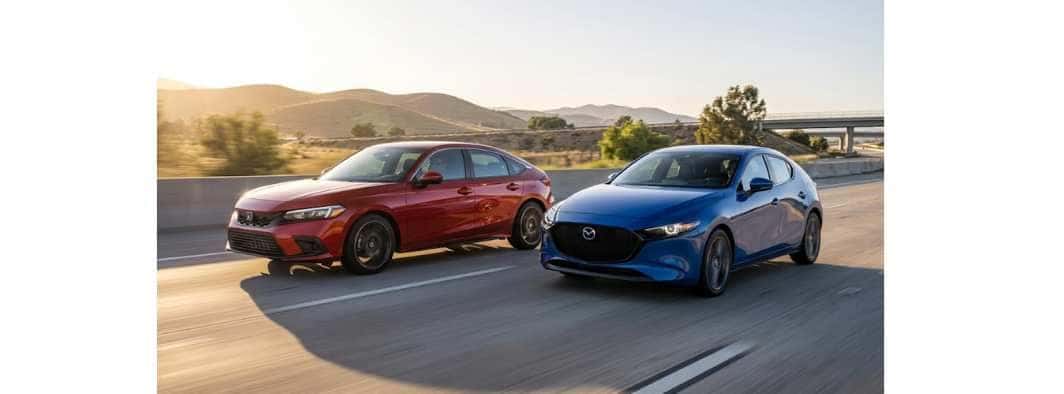
2026 Honda Civic Hatchback vs. 2026 Mazda 3: Why Versatility Wins
The compact car market is often a choice between style and substance. For 2026, the Mazda 3 leans heavily into its “Kodo” design language, offering a sleek, traditional silhouette. However, the 2026 Honda Civic Hatchback proves that you don’t have to choose. By combining the sleek lines of a sport coupe with the massive utility of a five-door hatch, Honda has created a vehicle that is objectively more useful, more efficient, and more advanced than the Mazda 3.
Fuel Economy: Hybrid Sophistication vs. Traditional Gas
In the 2026 landscape, fuel efficiency is the ultimate luxury. Honda’s new hybrid powertrain has set a bar that Mazda simply hasn’t reached.
- 2026 Honda Civic Hatchback: The standout is the Civic Sport Hybrid, which delivers a massive 50 MPG city and 45 MPG highway. Even the non-hybrid 2.0L models offer a competitive 30 city / 38 highway MPG. The hybrid doesn’t just save fuel; it delivers 200 horsepower and 232 lb-ft of torque, offering instant electric acceleration.
- 2026 Mazda 3: The Mazda 3 relies on a 2.5L engine that, while reliable, is thirsty by modern standards. The front-wheel-drive achieves only 27 city / 36 highway MPG. If you opt for the more powerful Turbo model, those numbers drop to a disappointing 23 city / 32 highway MPG.
The Honda Advantage: The Civic Hatchback gives you more power than the base Mazda 3 while delivering nearly double the city fuel economy. It is the smarter long-term financial choice.
Advanced Technology: Modernity vs. Minimalism
While Mazda prides itself on a “minimalist” interior that removes many touch controls, Honda has embraced a tech-forward approach that is easier to use in daily traffic.
The 2026 Civic Hatchback features an interior that feels lightyears ahead:
- Google Built-in: Available on the Sport Touring Hybrid, this integration allows you to use Google Maps and Google Assistant natively. Mazda lacks this, relying instead on a rotary dial system that can be cumbersome for navigating modern apps.
- Visibility and Safety: The Mazda 3 suffers from a high beltline and thick pillars that create significant blind spots. The Civic Hatchback is designed with a low cowl and thin A-pillars, offering best-in-class visibility.
- Honda Sensing®: Standard on every Civic Hatchback, this suite includes Traffic Jam Assist and a more sophisticated Road Departure Mitigation System than Mazda’s standard safety package.
Packages and Configurations
Honda’s trim structure for the Hatchback is designed to provide high-end features at every price point.
- Sport: Features 18-inch gloss-black wheels and a leather-wrapped steering wheel, offering a “tuner” look right from the factory.
- Sport Hybrid: The performance-meets-efficiency sweet spot with the 200hp electrified powertrain.
- Sport Touring Hybrid: The ultimate luxury hatch with leather-trimmed seats, a 12-speaker Bose® Premium Sound System, and a 9-inch touchscreen.
While the Mazda 3 offers many trims, the base “S” models feel significantly more “budget” than the Civic Sport, which comes standard with more aggressive styling and premium interior touches.
Why Honda is the Best Choice: The Utility Gap
The most dramatic difference between these two vehicles is cargo capacity. Because the Mazda 3 is a traditional car, it is limited by a small trunk opening and only 13.2 cubic feet of space.
The Honda Civic Hatchback, by contrast, offers a massive 24.5 cubic feet of cargo space—nearly double that of the Mazda. Because it is a hatchback, the entire rear glass lifts up, allowing you to load large boxes, bicycles, or camping gear that simply would not fit through the Mazda’s trunk lid.
When you combine this unmatched cargo versatility with 50 MPG and a more spacious rear seat (37.4 inches of legroom vs. Mazda’s cramped 35.1 inches), the 2026 Honda Civic Hatchback is the clear winner for anyone living an active, modern lifestyle. Take one for a test drive at Serra Honda O’Fallon, located in O’Fallon, IL, today!